


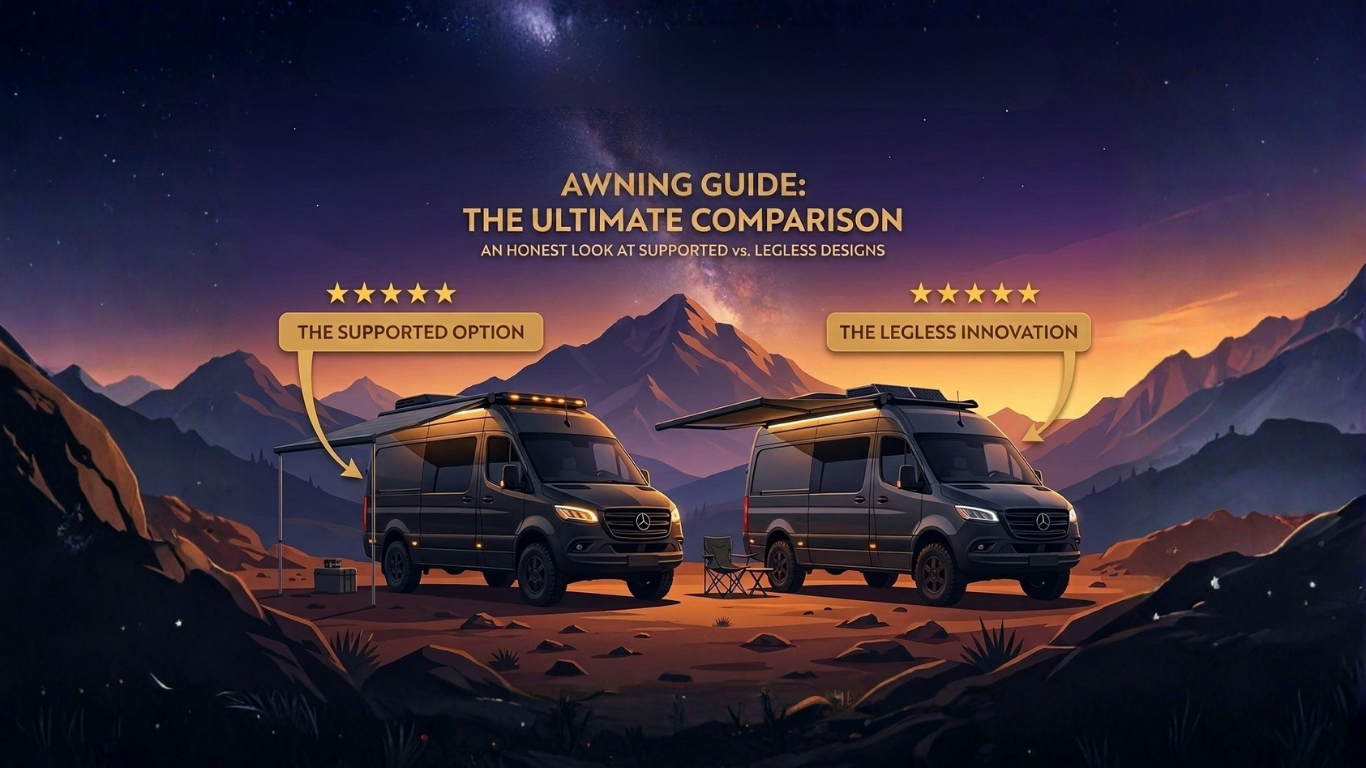
Best Van Awning for Sprinter, RV & Overland Builds: Nomadic A1 vs A2 Electric Awning Guide
Legless or supported? Same waterproof PVC canopy, two very different ownership experiences. Here’s the clear answer for vans, RVs, toy haulers, overland rigs, and expedition builds.

If you are trying to choose the best awning for a Sprinter van, camper van, RV, toy hauler, expedition truck, or overland-style build, you have probably seen the same problem over and over: lots of polished awning photos, not enough practical answers.
Most buyers do not just need shade. They need to know whether the awning fits the way their vehicle is mounted, how it will behave in real weather, whether it will get in the way of doors, camp kitchens, or loading zones, and whether it still feels like the right choice after months of actual use.
That is exactly what this guide is built to answer.
Instead of repeating vague awning language, this comparison breaks down the Nomadic A1 and Nomadic A2 around the things serious buyers actually care about: legless vs supported design, reinforced arm structure, mounting fit, weather behavior, motor setup, and which awning makes more sense for a Sprinter van, camper van, RV, toy hauler, overland rig, or expedition vehicle.
Quick answer:
- Choose the A1 if you want the more practical, utility-minded option: telescoping support legs, more flexibility on uneven ground, and a layout that feels stable and familiar for van, RV, and work-oriented use.
- Choose the A2 if you want the cleaner premium option: legless deployment, a more open side zone, and a reinforced arm structure built specifically to support the awning without legs.
- Both use waterproof 480 g/m² PVC fabric with UV protection and anti-mold performance, both extend to 8.2 feet, both use 6063-T3 aluminum and stainless hardware, both use tubular motor operation with internal stop-position control, and both carry a Level 5 wind resistance rating.
- For most buyers, the real decision is not “which awning sounds better?” It is “what type of awning will fit my rig and work better in real life?”
What Buyers in This Category Actually Need to Know
The best awning comparisons are not just about appearance. They are about fitment and workflow. Buyers in the van, RV, toy hauler, and expedition space are comparing mounting style, mounting requirements, structural support, weather behavior, and how the awning changes the usable space on the side of the vehicle.
That matters because the wrong awning does not just look wrong. It creates daily friction. It gets in the way of doors, interferes with cooking or loading, complicates the mounting plan, or feels less stable than the buyer expected once it is deployed.
Before you buy any awning, you should know:
- How it mounts to your van, RV, rack, or conversion body
- How the structure behaves once the awning is actually deployed
- How it handles real weather instead of showroom conditions
- Whether the company behind it can help when it is time to install, wire, or troubleshoot
Nomadic A1 vs A2 at a Glance
| Feature | Nomadic A1 | Nomadic A2 |
|---|---|---|
| Support style | Telescoping support legs integrated into the front bar | Legless design with reinforced arms |
| Arm construction | Standard supported arm structure | Aluminum arm components approximately 64% thicker than A1 |
| Fabric | PVC, 480 g/m², waterproof, UV protection, anti-mold, flame-resistant | PVC, 480 g/m², waterproof, UV protection, anti-mold, flame-resistant |
| Projection | 8.2 feet | 8.2 feet |
| Lighting | Single COB LED strip | Dual COB LED strip lighting |
| Construction | 6063-T3 aluminum frame, case, and mounting components with stainless hardware | 6063-T3 aluminum frame, case, and mounting components with stainless hardware |
| Motor | Tubular motor with internal stop-position control | Tubular motor with internal stop-position control |
| Wind rating | Level 5 / 19-24 mph | Level 5 / 19-24 mph |
| Best fit | Practical buyers who want visible support, uneven-ground flexibility, and a more traditional utility-focused feel | Premium-minded buyers who want clean side access, less clutter, and a more open under-awning space |

Legless vs Supported: The Decision That Changes Daily Ownership
This is the real split between the A1 and A2. The main decision is not canopy material or basic size. The main decision is whether you want a traditional supported awning with telescoping legs or a premium legless system with reinforced arms that carry the load without dropping supports to the ground.
A legless awning feels cleaner in everyday use. Nothing drops into your walking path. Nothing interferes with side doors, camp kitchens, or the loading side of a toy hauler. That is the A2 advantage, and it is bigger in daily life than it sounds on paper.
A supported awning feels more traditional and more utility-driven. You can see the support structure. You understand what it is doing. And if the campsite is imperfect, the A1’s integrated telescoping legs give you something practical to work with. That is not a downgrade. That is a different kind of value.
Why the A2 Costs More: The Arm Structure Has to Do More
A legless awning is not just “the same awning without legs.” It has to carry the load differently. That is why the A2 uses aluminum arm components that are approximately 64% thicker than the A1. The structure has to do the job the support legs would normally help with.
That means the A2’s premium story is not just visual. It is structural. Buyers are paying for a cleaner under-awning experience and the reinforced arm architecture required to support it.
What that thicker arm structure buys you:
- a cleaner, legless campsite footprint
- better side-door and loading-zone freedom
- a more premium look on vans, RVs, and expedition builds
- a structure engineered to support the awning without relying on ground legs
Same Waterproof PVC Canopy, Different Structural Personality
Both the A1 and A2 use the same canopy material: PVC, 480 g/m², waterproof, UV protection, anti-mold performance, and flame-resistant. That makes the buying decision cleaner. You are not choosing between radically different canopy materials. You are choosing between two structural approaches built around the same durable canopy logic.
The 480 g/m² spec is worth stating because it shows Nomadic is not hiding the canopy weight behind vague claims. At the same time, it should not be the whole sales pitch. In this category, a serious canopy spec matters, but structure, mounting, and real-world usability matter even more.
Mounting Reality: This Is Where Buyers Either Win or Regret the Purchase
If you are shopping for a powered awning for a van, RV, toy hauler, or expedition truck, mounting logic matters almost as much as the awning itself. This is where a lot of buyers get burned. They focus on the look, ignore the mounting plan, and only start asking the hard questions once the awning is already in the shop.
For the Nomadic A1 and A2, the better way to think about mounting is simple: the awning needs a flat, structurally capable mounting surface with proper plate alignment, bolt access, and enough support for the awning load. The included mounting plates may be used on flat surfaces or compatible roof racks with at least 6 inches of rack height. That height matters because the plate uses four bolts, and both the top and bottom of the plate need to be secured correctly.
That means a roof rack install is possible, but it is not automatically universal. The rack still needs enough height, strength, geometry, and bolt access for the included plates to be installed correctly. Curved, angled, uneven, or non-level mounting surfaces do not have a standard direct-mount path and may require spacers, backing plates, adapters, or a custom flat mounting solution before installation.
What buyers need to know about mounting:
- Flat mounting surfaces: the cleanest and most straightforward fitment path
- Compatible roof racks: possible when the rack provides at least 6 inches of height, proper structure, plate alignment, and bolt access
- Included mounting plates: may be used on flat surfaces or compatible roof racks when the plate can be secured at both the top and bottom with all four bolts
- Curved or angled surfaces: no standard direct-mount solution; the mounting surface must be corrected with an appropriate flat, structurally capable solution
That is why support and fitment guidance matter so much. A product can look impressive online and still become a headache if rack height, plate alignment, bolt access, mounting strength, or the wiring path were not thought through correctly.
Motor Quality, Controlled Operation, and Why Cheap Powered Awnings Disappoint
A powered awning is not just shade fabric in a box. It is a moving system that has to extend, retract, stop cleanly, and repeat that process over and over in real travel conditions. That is why motor quality matters more than many buyers realize.
The A1 and A2 use a tubular motor with internal stop-position control. That matters because it supports cleaner, more repeatable powered operation without making the awning feel cheap or unpredictable. It is the kind of detail that separates a better awning from the kind of bargain-first powered unit that looks fine on day one and becomes annoying once it has lived through real use.
Why better powered hardware matters:
- cleaner stop-position control during extension and retraction
- a more polished day-to-day ownership feel
- less of the “cheap powered accessory” feeling common in low-end alternatives
- better confidence in a system you will use repeatedly, not just occasionally

Where Each One Fits Best
This is where the A1 and A2 stop being abstract products and start becoming better or worse choices for a real build. The stronger answer depends on how the side of the vehicle is actually used once the awning is out.
For Sprinter vans and camper vans, the A2 is usually the cleaner premium answer if the buyer cares about side-door access, camp-kitchen flow, and a less cluttered exterior setup. The A1 is usually the more practical answer if the buyer values visible support, a familiar setup, and utility-minded deployment. With either awning, the mounting surface, roof rack height, plate alignment, structure, and bolt access should be reviewed before installation.
For RVs, the A1 often feels more intuitive to traditional buyers because the supported structure reads as practical and familiar. The A2 still makes strong sense for buyers chasing a cleaner premium look and a more open patio-style side zone.
For toy haulers, the A2 often has the edge because the legless layout keeps the loading side cleaner when people, gear, and toys are constantly moving in and out. The A1 still works well when the buyer wants visible support and a more traditional structure.
For overland and expedition-style builds, the decision usually comes down to workflow. If you want cleaner access and less visual clutter, the A2 is the stronger fit. If you want more obvious support and more forgiving behavior on uneven terrain, the A1 makes more sense.
A simple way to think about it:
- A1 = more practical, more traditional, better when visible support and uneven-ground flexibility matter most
- A2 = cleaner, more premium, better when side-zone freedom and uncluttered use matter most
- Both = waterproof PVC with UV protection and anti-mold performance, powered operation, real weather intent, and a stronger ownership story than vague bargain-first alternatives
Who Each Awning Is Actually For
The A1 is the smarter buy for buyers who want electric deployment, visible support, waterproof PVC, and a structure that makes sense on imperfect terrain and practical-use rigs. It is the better fit when the buyer values function first and wants an awning that feels stable, familiar, and straightforward.
The A2 is the smarter buy for buyers who want the cleaner legless experience, more open usable space, reinforced arms, and a more refined overall ownership feel. It is the better fit when the buyer wants the side of the vehicle to stay cleaner and more usable once the awning is deployed.
That is the real point of this comparison. Neither awning is “better” in the abstract. The better awning is the one whose structure matches how the rig is parked, loaded, cooked around, and lived around in the real world.
Real Install Inspiration
One of the fastest ways to build trust with buyers in this segment is to show real installed examples. Vans, RVs, toy haulers, and expedition builds all package awnings differently, and seeing real customer, builder, or influencer installs helps people picture the awning on their own rig much faster than a spec sheet ever will.
That is especially true when buyers are comparing rack-mounted installs, side-wall installs, lighting in actual campsite conditions, and the visual difference between a supported awning and a legless one on a finished vehicle.
Real install photos work here because they act as proof, not decoration. They help people see the awning on finished rigs, understand fitment better, and trust that the product belongs on the kinds of builds they actually admire.


Swipe or scroll sideways to view real A-Series awning installs and lifestyle setups.
The Honest Verdict
The A1 is the smarter buy for utility-minded buyers. It gives you powered convenience, integrated support legs, waterproof PVC fabric, and a structure that makes sense for buyers who lean practical before premium.
The A2 is the smarter buy for premium-minded buyers. It gives you the cleaner legless experience, reinforced arms, more open usable space, and a more refined under-awning experience once deployed.
So which one is the best awning for a Sprinter van, RV, toy hauler, or expedition vehicle? Not the one with the flashiest description. The one whose structure actually matches how you park, travel, load, cook, and live around your rig.
Frequently Asked Questions
What is the best van awning for most buyers?
Is a legless awning better than an awning with legs?
What fabric do the A1 and A2 use?
Can the A1 and A2 be mounted to roof racks?
Which awning is better for a toy hauler?
What is the wind rating of the A1 and A2?
Related Resources
- Explore the full Nomadic Awnings lineup
- View the Nomadic A1 electric awning
- View the Nomadic A2 legless electric awning
- Download additional Nomadic resources
Ready to choose the right awning without guessing?
If you want visible support, uneven-ground practicality, and a utility-first setup, start with the A1. If you want premium legless convenience and a cleaner side-zone experience, start with the A2.
Need help choosing? Call us at 833-287-9500 or email support@nomadicinnovations.com.
Nomadic Innovations
We Never Stop Innovating
Share:
S1 Helix Split Truck AC Guide: 12V & 48V Electric APU Alternative
How to Add Smart App Control to a 12V RV or Van Awning?