


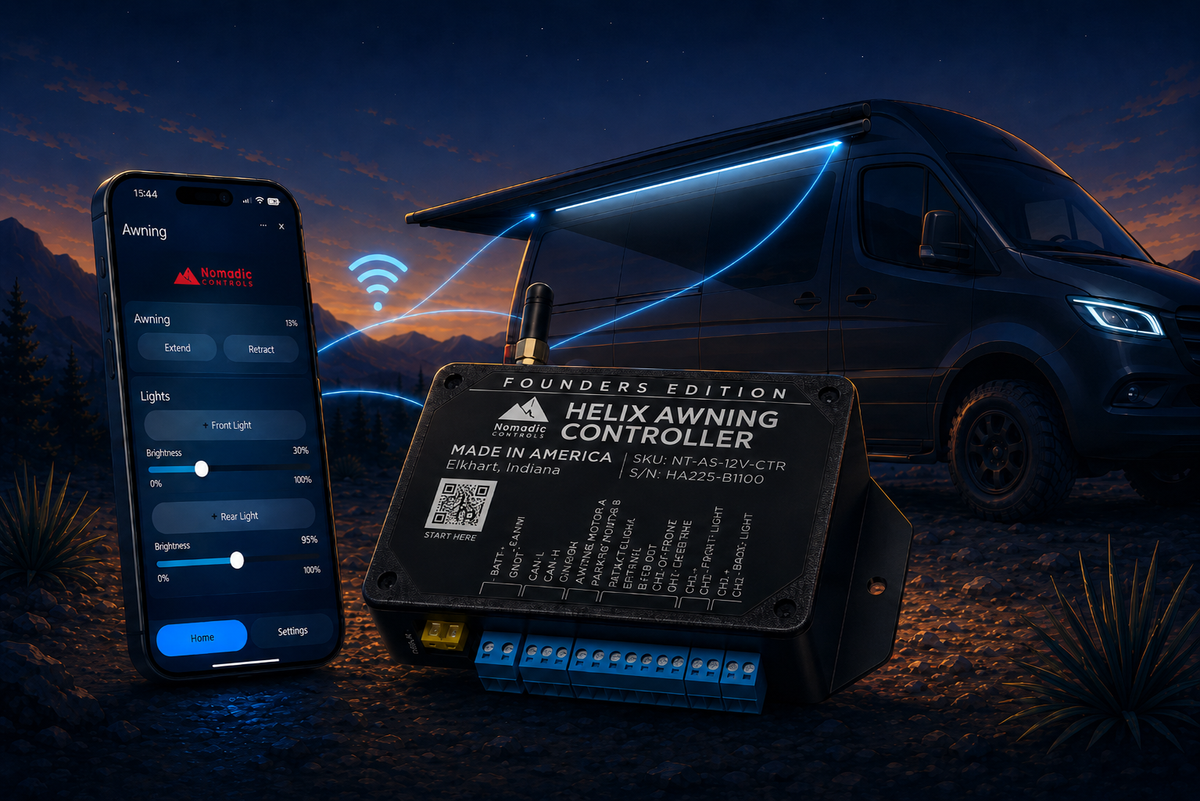
How to Add Smart App Control to a 12V RV or Van Awning
A practical guide to 12V awning control, app-based operation, hardwired switches, PWM light dimming, ignition restriction, and what to check before upgrading your awning.

Most electric awnings are easy to understand from the outside. They extend, retract, and create shade. The control side is harder to explain because the most important part may just look like a black box with wires going into it.
But that control box is exactly where the daily ownership experience changes. A well-designed smart 12V awning controller can give a van, RV, toy hauler, or overland build cleaner app control, physical switch support, lighting control, safety-minded logic, and clearer electrical limits. A poorly matched controller can create confusion, wiring problems, poor compatibility, or support headaches.
This guide explains what a smart awning controller actually does, what to check before adding one, and why the Helix Awning Controller was built first around Nomadic A1 and A2 electric awnings before expanding into select third-party 12V awning applications.
Quick takeaway:
- A smart awning controller is not just a remote. It manages awning movement, lighting outputs, switch inputs, power limits, and system logic.
- Compatibility depends on the electrical system. Motor type, voltage, wiring layout, current draw, lighting load, and install location matter more than brand name alone.
- App control is useful, but physical switches still matter. Serious van and RV builds should not depend on a phone as the only control point.
- Helix was built first for Nomadic A1 and A2 awnings, with select 12V third-party compatibility possible when the system specs match.
What a Smart 12V Awning Controller Actually Does
A basic awning switch usually does one job: send power one direction to extend the awning and the opposite direction to retract it. That works, but it does not give the owner much intelligence, flexibility, or integration.
A smarter 12V awning controller sits between the vehicle electrical system, the awning motor, the lighting circuits, the physical switches, and the app. Instead of treating the awning like a simple on/off accessory, it gives the system a defined control path.
- Motor control: extend and retract a compatible 12V DC awning motor.
- Lighting control: manage one or two compatible 12V awning light channels.
- Dimming: support PWM brightness control for compatible LED lighting loads.
- Physical switch inputs: allow normal wall, cabinet, galley, or switch-panel controls inside the vehicle.
- App control: give owners phone-based awning movement, lighting, brightness, and status visibility.
- Protection and logic: use defined current limits, fused protection, low-voltage behavior, and ignition-aware control where applicable.
The practical difference: A smart awning controller turns the awning from a basic powered accessory into a managed system with clearer control, cleaner wiring options, and better day-to-day usability.
Why App Control Alone Is Not Enough
App control is the feature people notice first. It is easy to understand and easy to market: open the app, extend the awning, retract the awning, adjust the lights, and check basic status. That is valuable.
But in a real van, RV, or overland build, app control should not be the only way to operate something as physical as an awning. Phones get misplaced. Batteries die. Wi-Fi and Bluetooth behavior can vary by environment. People also want a familiar control point near the door, galley, bed, cabinet, or switch panel.
That is why a serious awning control setup should support both app-based operation and hardwired physical switches. The app gives convenience. The switches give familiarity and practical control in daily use.

Why Lighting Control Matters More Than People Think
Awning lights are not just a small add-on. On a van or RV, the awning light often becomes the main camp-side lighting. It affects cooking, loading, working, walking around the vehicle, and how comfortable the outside space feels at night.
Basic light control usually means on or off. That is not always enough. A bright awning light can be useful when setting up camp, but too harsh when people are sitting outside or winding down for the night. PWM dimming gives the owner better control over the actual campsite experience.
This is especially important on awnings with more than one light channel. A Nomadic A1 awning typically uses a single front light channel, while a Nomadic A2 awning can support front and back lighting when equipped. A controller that understands single-light and dual-light setups can create a cleaner experience for both.
Good awning light control should answer three questions:
- Is the lighting compatible with the controller output?
- Is the lighting load within the allowed wattage and amperage limit?
- Does the owner need one light channel or two?
Why Helix Was Built First for Nomadic A1 and A2 Awnings
The Helix Awning Controller was built first around Nomadic A1 and A2 electric awnings. That is intentional. Starting with the awnings already in the Nomadic ecosystem makes the fitment easier to explain, the customer path cleaner, and the support conversation more controlled.
That does not mean the controller can never work outside of Nomadic awnings. It means the first and cleanest target is the customer who already owns, or is planning to buy, a Nomadic A-Series awning. From there, select 12V third-party compatibility can be explored more carefully as more real-world installation data is gathered.

Can a Smart Awning Controller Work With Third-Party 12V Awnings?
Potentially, yes. But this is where people need to slow down. A controller should not be called universal just because an awning is electric or runs on 12V. The details matter.
For a third-party awning to be a realistic candidate, the installer needs to confirm the actual motor type, voltage, wiring layout, current draw, lighting setup, switch behavior, and installation environment. Brand name alone is not enough. Awning size alone is not enough. Even two awnings that look similar from the outside can use different control logic inside.
Before connecting any non-Nomadic awning, check these items:
- 12V DC motor: the awning must use a compatible 12V DC electric motor system.
- 2-wire motor output: the motor wiring must support the controller’s 12V 2-wire extend/retract output.
- Motor load: the motor must stay within the 60W max / 5A max motor output limit.
- Lighting: any connected lights must be compatible 12V lighting loads and stay within the controller’s lighting limits.
- Total current: the full connected system must remain within the 8A max total system current rating.
- Switch behavior: hardwired inputs must use normally-open momentary switches, not maintained or latching switches.
- Install location: the controller must be installed in a dry, protected location away from water, spray, condensation, direct weather, and heavy dust.
Builder note: The cleanest third-party compatibility conversations start with photos of the motor label, existing controller, switch panel, wiring layout, light setup, and power source. Guessing from the awning brand alone is how support problems start.
Why Helix Does Not Rely on Built-In Wind Auto-Retraction
Wind sensors sound good in theory. The idea is simple: if the wind gets too strong, the awning retracts automatically. In real-world use, the situation is more complicated.
Short gusts, vibration, vehicle movement, temporary sensor behavior, and inconsistent conditions can create nuisance events. That does not mean wind sensors are useless. It means automatic wind-triggered retraction should not be treated as a replacement for judgment, supervision, and responsible awning use.
The Helix Awning Controller is built around deliberate app and hardwired control. Awning movement stays tied to a clear user command instead of creating false confidence around weather automation.

The Electrical Specs Builders Should Care About
Specs are not just there to fill a table. On a product like this, the specs decide whether the controller belongs in a build at all. Before ordering or installing a smart 12V awning controller, builders should check the power system, motor load, lighting load, switch inputs, protection, and installation environment.
| Spec Area | Helix Awning Controller | Why It Matters |
|---|---|---|
| System voltage | 12V DC | The controller is built for 12V systems. Higher-voltage battery banks require proper DC-to-DC conversion. |
| Operating range | 8V to 14V DC | Voltage behavior matters in real vehicle electrical systems. |
| Motor output | 12V DC, 2-wire motor, H-bridge drive | The awning motor must match the controller’s output method. |
| Motor limit | 60W max / 5A max | Oversized or incompatible motors should not be connected. |
| Light outputs | Two independent 12V channels | Supports single-light and dual-light awning setups when equipped. |
| Light channel limit | 80W max per channel / 6.67A | Lighting load should be verified before wiring. |
| Total system current | 8A max | The full connected system must stay within the controller’s total current rating. |
| Switch inputs | +12V normally-open momentary inputs | Physical controls must be momentary switches, not maintained or latching switches. |
| Internal fuse | 10A blade fuse, installed | Protection is part of the control module design, but the full vehicle circuit still needs proper source-side protection. |
| Environment | Not sealed; install in dry, protected location | The controller should not be mounted outside or exposed to water, spray, condensation, direct weather, or heavy dust. |
A full technical specification table should always be checked before installation. Once the final manual is available, review the latest Helix Awning Controller manual before wiring the controller.
What About 48V Battery Systems?
A lot of modern van and expedition builds are moving toward 48V battery systems. That does not mean every accessory should run directly from 48V. The Helix Awning Controller is a 12V DC controller, so a 48V battery system must supply it through a properly rated 48V-to-12V DC converter.
Do not connect a 12V awning controller directly to 48V power. The electrical system needs to be designed so the controller, awning motor, lighting circuits, switch inputs, and circuit protection all match the required 12V control environment.
Simple rule: A 48V build can still use 12V accessories, but only when the power conversion, wiring, protection, and load calculations are handled correctly.
Founder’s Edition: Why Early Adopters Matter
The Helix Awning Controller is being introduced as a Founder’s Edition early access release. That matters because this is the stage where the product moves from controlled development into real customer and builder feedback.
For early adopters, the value is not just getting the product first. It is helping shape how the control platform is explained, installed, supported, and expanded over time. The first focus is Nomadic A1 and A2 awning owners because those are the cleanest fits to support first. As more installs are completed and more information is gathered, the third-party 12V awning opportunity can be handled with better data and fewer assumptions.
Founder’s Edition is best for:
- Nomadic A1 and A2 awning owners who want to add smart control
- builders comfortable with 12V wiring and proper circuit protection
- early adopters who understand that documentation and support materials may continue improving during launch
- customers who want app control, hardwired switch support, PWM light dimming, and a cleaner control path for their awning
Who Should Consider the Helix Awning Controller?
The Helix Awning Controller is not for every awning and not for every buyer. It makes the most sense when the owner or builder wants a more finished control experience and the awning’s electrical system matches the controller’s requirements.
- Nomadic A1 owners who want app-based awning control, front light control, PWM dimming, and physical switch support.
- Nomadic A2 owners who want smart control with support for front and back lighting when equipped.
- Van and RV builders who want physical switch inputs instead of an app-only setup.
- Overland and expedition builds where serviceability, clean wiring, and clear electrical limits matter.
- Select third-party 12V awning owners who can confirm the motor, lighting, current, wiring, and install environment requirements before ordering.
Ready to Add Smart Control to Your Awning?
Start with the Helix Awning Controller product page, then review compatibility carefully before ordering. If you are unsure about your awning, send the details to Nomadic Support first.
View the Helix Awning ControllerFrequently Asked Questions
Can I add app control to any RV awning?
Does the Helix Awning Controller require Helix Pulse?
Can I still use physical awning switches?
Can Helix dim awning lights?
Does Helix include automatic wind retraction?
Is the controller waterproof?
Does it work with 48V battery systems?
Final Thought
A smart awning controller is easy to underestimate because it does not look as dramatic as the awning itself. But for daily use, it can matter just as much. The controller decides how the awning moves, how the lights behave, how physical switches fit into the build, how the app experience feels, and how clearly the system can be supported.
The better question is not simply, “Can this make my awning smart?” The better question is, “Does this controller match the way my awning, wiring, lights, and vehicle electrical system actually work?”
That is the question the Helix Awning Controller page is built to answer — first for Nomadic A1 and A2 awning owners, and carefully for select 12V awning systems where the specs line up.